
Medically reviewed by the HealthClino Medical Review Team. Last updated: July 30, 2026. This article is for general information only and does not replace personalized medical advice — see the disclaimer at the end.
If you have severe difficulty breathing, chest pain, a high fever that won't come down, or signs of sepsis (confusion, rapid breathing, a rash that doesn't fade under pressure, feeling extremely unwell), seek emergency care immediately. Antibiotics, whether prescribed online or in person, are never a substitute for urgent treatment when your condition is deteriorating fast.
There's a reason "do I need antibiotics for this?" is one of the most common things people type into a search bar or ask a doctor. Everyone's had a sore throat that won't ease up, or a cough that's dragged on a week too long, and reached the same conclusion: surely this needs something stronger than rest.
Most of what people believe about antibiotics, though, is a mix of half-truths passed down from parents, pharmacists, and old prescriptions that happened to work once. Some of it is genuinely outdated. Some of it was never true. All of it matters, because getting this wrong doesn't just mean an unnecessary side effect — it's part of a much bigger problem in modern medicine. Let's go through the myths doctors hear most often, and what's actually true.
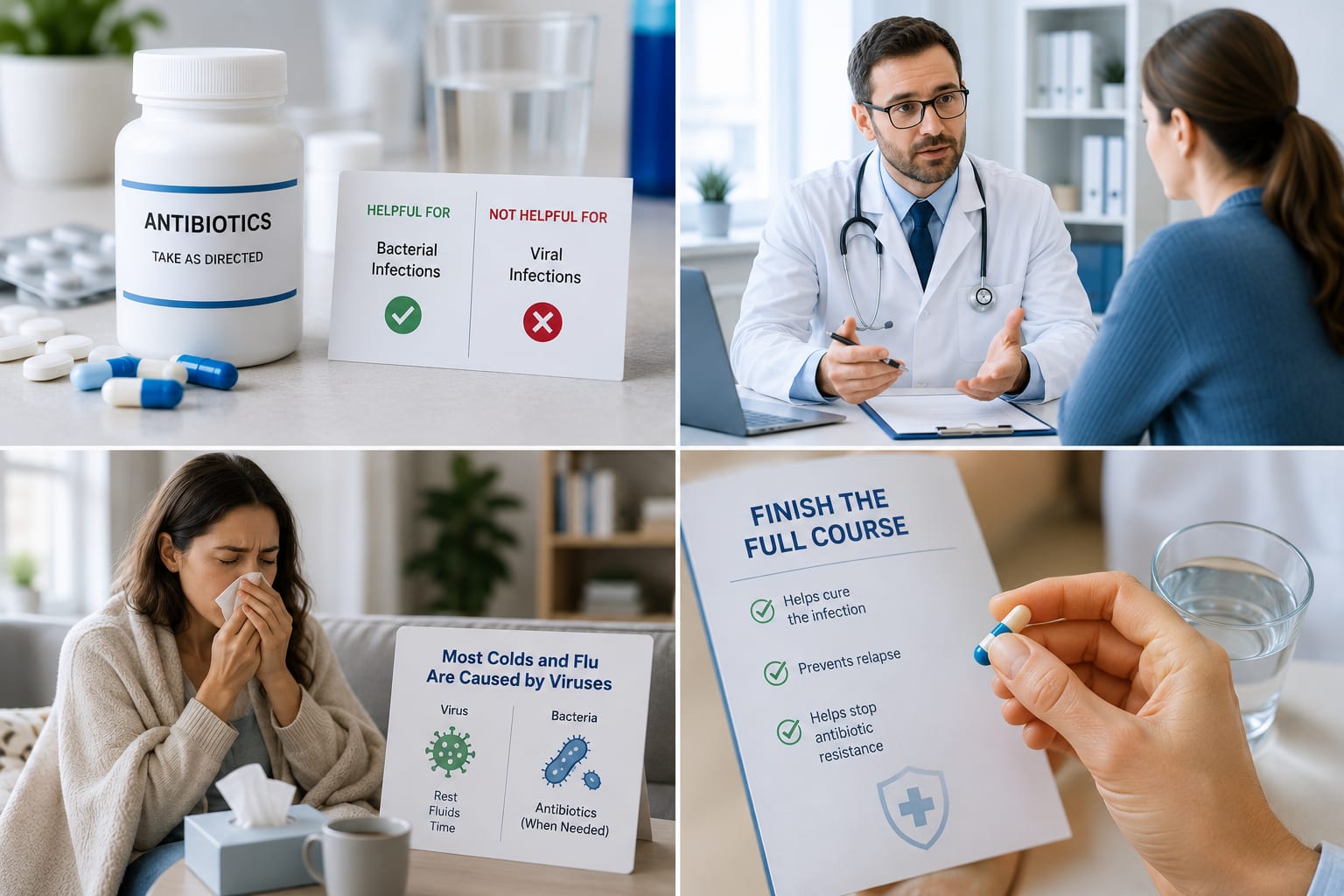
Myth: "Antibiotics will clear up my cold or flu faster."
Truth: Colds and flu are viral, and antibiotics only work on bacteria. Taking them for a viral illness doesn't shorten it by a single day — you'll recover on your own timeline either way, usually within a week to ten days, and the antibiotic will have done nothing except expose your gut to a medication it didn't need. This is the single most common reason doctors decline an antibiotic request, and it's not stinginess — it's the medicine doing exactly what it's supposed to do.
Myth: "Green or yellow mucus means it's bacterial."
Truth: This one is everywhere, and it's not reliable. Mucus changing colour during a viral infection is completely normal — it's just white blood cells doing their job, not proof that bacteria have taken over. Doctors look at a broader pattern instead: how long symptoms have lasted, whether they're improving or getting worse, whether the fever is high or sudden, and whether pain is localized to one specific area (one ear, one sinus, the throat) rather than spread across several symptoms at once. Colour of discharge on its own tells a doctor very little.
Myth: "If I ask nicely, a doctor should just prescribe them to be safe."
Truth: A responsible doctor won't prescribe "just in case," and that includes online consultations. Can an online doctor prescribe antibiotics? Yes, when it's clinically justified — the reasoning is exactly the same as an in-person visit. The doctor asks about your symptoms, how long you've had them, and whether they're improving or worsening, and in some cases may recommend a test (a throat swab, a urine sample) before confirming anything. If the picture is clearly viral, a doctor prescribing antibiotics anyway isn't doing you a favour — it's a real risk with no real benefit, and a good doctor will say so and explain what will actually help instead. Doctors on our platform are licensed, regulated professionals who follow the medical and prescribing rules of wherever they're licensed, and patient safety comes before completing a request. When a prescription is genuinely appropriate, it goes straight to a pharmacy of your choice, or you can arrange it through our medication order service.
Myth: "Stopping antibiotics once I feel better is fine."
Truth: It isn't, unless a doctor specifically tells you it's okay for that particular course. Stopping early can leave some of the tougher bacteria alive — the ones your immune system hadn't fully cleared yet — and give them a chance to adapt. That's one of the most direct, individual-level contributors to antibiotic resistance, which is a much bigger deal than most people realize (more on that below).
Myth: "All infections eventually need antibiotics to fully heal."
Truth: Most don't. Here's roughly how it breaks down:
Usually viral — antibiotics won't help:
- The common cold, always
- Flu (though antivirals exist for specific higher-risk cases)
- Most sore throats, especially alongside a cough or runny nose
- Most coughs and bronchitis, even ones lasting two to three weeks
- Most sinus infections in their first week
Often bacterial — antibiotics may be needed:
- Urinary tract infections (UTIs) — nearly always bacterial, and can spread to the kidneys if ignored
- Strep throat, once confirmed — important to treat properly in children especially, to avoid complications like rheumatic fever
- Sinus infections that persist past 10 days or worsen after initially improving
- Confirmed bacterial ear infections, particularly with severe pain or high fever in young children
- Bacterial pneumonia — fever, breathlessness, and abnormal chest sounds together
- Cellulitis and other bacterial skin infections with spreading redness, warmth, and swelling
Even for the "often bacterial" list, a doctor is confirming, not assuming. A sinus infection in its first three days is still far more likely to be viral, which is why guidance generally favours waiting a little before reaching for antibiotics unless something looks more serious.
Myth: "A quick online consultation can't properly tell viral from bacterial."
Truth: It genuinely can, for a large share of cases — with the honest caveat that some situations need more than a screen can offer. A doctor on a video call is doing the same clinical reasoning an in-person GP would: symptom pattern, timeline, severity, and follow-up questions that narrow things down. Someone with a sore throat, mild fever, and a cough that started gradually fits a fairly classic viral pattern a doctor can assess confidently online. Someone with one-sided ear pain, a sudden high fever, and no other symptoms is a different pattern, and might still need that consultation as the first step even if it leads to an in-person exam or a test afterward.
What a telehealth doctor genuinely can't do is examine your throat with a proper light, listen to your chest with a stethoscope, or run a lab test over video. In cases where that level of examination matters — a genuinely uncertain sore throat, suspected pneumonia, a complicated UTI — a good doctor will say so and refer you onward rather than guess. That's the system working correctly, not failing you.
Myth: "One unnecessary course of antibiotics doesn't really matter."
Truth: Individually, maybe not much. At scale, it adds up to one of the more serious problems in modern medicine — antibiotic resistance. Every time antibiotics are used, whether appropriately or not, some bacteria survive and can adapt to resist that drug. The European Centre for Disease Prevention and Control (ECDC) has tracked rising antibiotic resistance across the EU for years, and the WHO has repeatedly listed antimicrobial resistance among the top global public health threats, warning that infections which are simple to treat today could become genuinely difficult to manage if the trend continues.
This isn't hypothetical. Resistant bacteria are already behind infections that don't respond to first-line antibiotics, which means longer illness, more complicated treatment, and in serious cases, infections that are much harder to bring under control. Every unnecessary prescription is a small contribution to that. It's exactly why a doctor turning down an antibiotic request for a clearly viral illness isn't being unhelpful — they're doing the job the way it's supposed to be done.
Common Questions
How long does it take to know if I need antibiotics? Often one consultation is enough if the pattern is clear. In more ambiguous cases, doctors sometimes suggest a short "watch and wait" period, or a test, before deciding — that's standard practice, not a delay tactic.
Can antibiotics have side effects? Yes — the most common are nausea, diarrhoea, and yeast infections, and less commonly, allergic reactions ranging from a mild rash to something more serious requiring urgent care. It's one more reason they're prescribed only when there's a real need for them.
Do children need a different approach? Children are assessed with the same viral-vs-bacterial reasoning, but doctors weigh age-specific risks more carefully — ear infections and strep throat, for instance, carry different considerations in young children than in adults. It's exactly the kind of nuance a general practitioner online consultation can talk a parent through.
Is my information kept private during an online consultation? Yes. Consultations run through a secure platform, and your health data is handled in line with GDPR and relevant national healthcare privacy regulations. Full details are in our privacy policy.
Have a question this article hasn't answered? Our full FAQs page covers more ground.
When to Seek Medical Help
Book a consultation — online or in person — if you have:
- A sore throat, ear pain, sinus pain, or urinary symptoms lasting more than a few days without improvement
- A fever that's high, sudden, or that returns after initially settling
- Symptoms getting worse after the first week instead of easing off
- Pus, thick discharge, or visibly spreading redness and swelling
Seek emergency care immediately if you or someone you're with has difficulty breathing, chest pain, confusion, a rash that doesn't fade when pressed, or any other sign of a rapidly worsening infection. That's not a situation for a routine booking — it needs urgent, in-person assessment.
Book an Online GP Consultation
Whether it's a lingering cough, a suspected UTI, or a sore throat that's gone on too long, the fastest way to actually know whether you need antibiotics is a real conversation with a doctor — not guesswork, and not finishing off leftover medication from last time. A quick online doctor consultation can tell you clearly whether you're dealing with something viral that just needs time, or something bacterial that needs treatment.
Not sure if what you have needs antibiotics? Book an appointment and get a clear, medically grounded answer.
Medical disclaimer: This article is provided for general informational purposes only and is not a substitute for professional medical advice, diagnosis, or treatment. Whether antibiotics are appropriate for any individual case depends entirely on assessment by a qualified doctor, taking into account your specific symptoms, history, and, where needed, physical examination or testing. Doctors providing consultations through this platform are licensed and regulated professionals who practice in accordance with the medical and prescribing regulations of their country of licensure, and may decline to prescribe antibiotics where it is not clinically appropriate. If you think you may have a medical emergency, seek immediate in-person or emergency care rather than booking an online consultation. Never disregard professional medical advice or delay seeking it because of something you've read here.
This article was medically reviewed by the HealthClino Medical Review Team on July 30, 2026 for clinical accuracy. It is reviewed periodically and updated to reflect current medical guidance and regulatory changes. Sources referenced include World Health Organization (WHO) guidance on antimicrobial resistance, the European Centre for Disease Prevention and Control (ECDC), and publicly available national clinical guidance on antibiotic prescribing. Patient data shared during consultations is handled in accordance with GDPR and applicable national healthcare privacy regulations — for full details, see our privacy policy and terms and conditions.