
Medically reviewed by the HealthClino Medical Review Team
Last updated: August 29, 2026
An online doctor consultation allows you to speak with a healthcare professional remotely using video, telephone, or secure digital communication instead of attending a clinic in person. For many non-emergency health concerns, this can make accessing medical advice more convenient while still allowing a qualified doctor to assess whether online care is appropriate.
You may have had a sore throat that's been getting worse for two days. Perhaps you've developed a rash and want a medical opinion. Or maybe you need a follow-up appointment and would rather not spend time travelling to a clinic or waiting in a reception area.
These are situations where an online doctor consultation may be useful.
But if you've never used online healthcare before, you probably have questions. Is it a real doctor? Can an online doctor prescribe medication? How much does an online consultation cost? Is your health information secure? And how can you tell whether an online healthcare provider is legitimate?
This guide explains how online doctor consultations work, what they can and cannot be used for, what they may cost, how to choose a safe provider, and how to prepare for your appointment.
If you need a general practitioner, you can also learn more about our GP consultation online service.
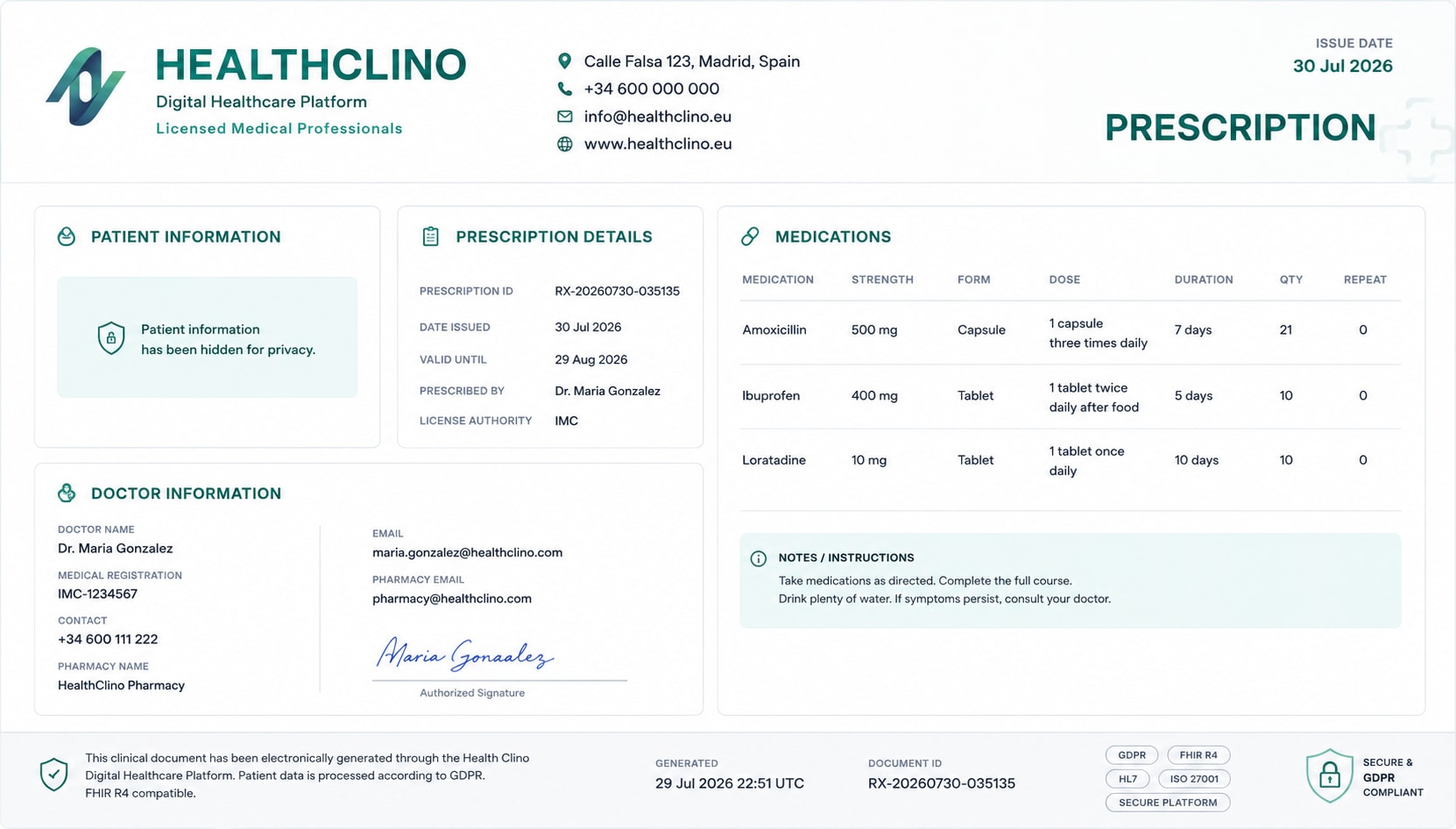
What Is an Online Doctor Consultation?
An online doctor consultation is a medical consultation that takes place remotely using technology such as video, telephone, or secure online communication.
It is part of the broader field of telemedicine. Telemedicine allows healthcare professionals to provide selected clinical services remotely when distance is a factor. Depending on the service, telemedicine may involve a live video or telephone consultation, or an asynchronous consultation where information is submitted and reviewed later by a healthcare professional.
During an online consultation, a doctor may:
Ask about your symptoms and medical history
Review your current medications and allergies
Assess the information you provide
Review photographs or documents when appropriate
Provide medical advice
Recommend treatment when clinically appropriate
Issue certain prescriptions or medical documents where legally permitted
Recommend an in-person examination or further testing
Refer you to another healthcare professional or service
The doctor makes these decisions based on the information available during the consultation and the laws and professional requirements that apply where the healthcare is provided.
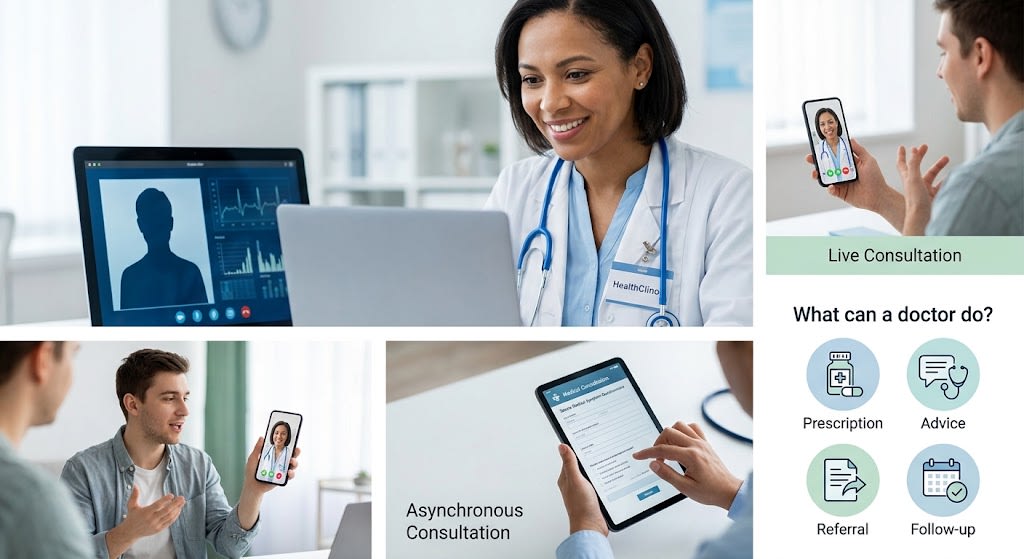
What Types of Online Doctor Consultations Are Available?
There are two common formats.
Live consultations
A live consultation takes place in real time through video or telephone. You speak directly with a doctor, similar to a traditional appointment but remotely.
Live consultations can be useful when the doctor needs to ask questions interactively or visually assess something such as a skin problem, swelling, or another visible symptom.
Asynchronous consultations
With an asynchronous consultation, you provide information through a secure form or messaging system. You may also be asked to upload photographs or relevant documents. A healthcare professional then reviews the information and responds within the provider's stated timeframe.
This format can be useful for selected routine concerns where a live appointment is not necessary.
At HealthClino, the type of consultation available depends on the service and clinical circumstances.
How Does an Online Doctor Consultation Work?
An online doctor consultation is usually straightforward, although the exact process varies between providers.
1. Choose the Appropriate Consultation
Start by identifying the type of medical help you need.
For example, you may need:
A general practitioner consultation
Advice about a common illness
A follow-up consultation
A prescription review or renewal
Advice about a skin condition
A medical certificate where appropriate
Further medical assessment or referral
If your symptoms could represent a medical emergency, do not use an online consultation as a substitute for emergency care.
You can explore available online doctor services to see which options may be relevant to your needs.
2. Provide Your Medical Information
You may be asked about:
Your current symptoms
When the symptoms started
Whether they are getting better or worse
Existing medical conditions
Current medications
Allergies
Previous relevant medical history
Be as specific as possible.
For example:
"I have had stomach pain for three days, it becomes worse after eating, and I have not had a fever."
is more useful than:
"My stomach hurts."
Accurate information gives the doctor more useful context for assessing your situation.
3. Connect With the Doctor
Depending on the service, you may join a video consultation, speak by telephone, or receive a response through a secure online system.
You can browse our doctors before booking if you want to learn more about the healthcare professionals available through the platform.
4. Discuss Your Symptoms and Medical Needs
The doctor will ask questions and review the information you provide.
Depending on your circumstances, the doctor may:
Provide medical advice
Recommend treatment
Request additional information
Recommend an examination or test
Issue an appropriate prescription or medical document
Refer you for in-person care
Online healthcare has limitations. A doctor may therefore recommend that you attend a clinic or another healthcare service when a physical examination, diagnostic test, or urgent assessment is necessary.
5. Receive Your Next Steps
After the consultation, you may receive appropriate documentation through your patient account or another secure method.
Depending on the consultation and applicable regulations, this could include:
A prescription
A referral
A medical certificate
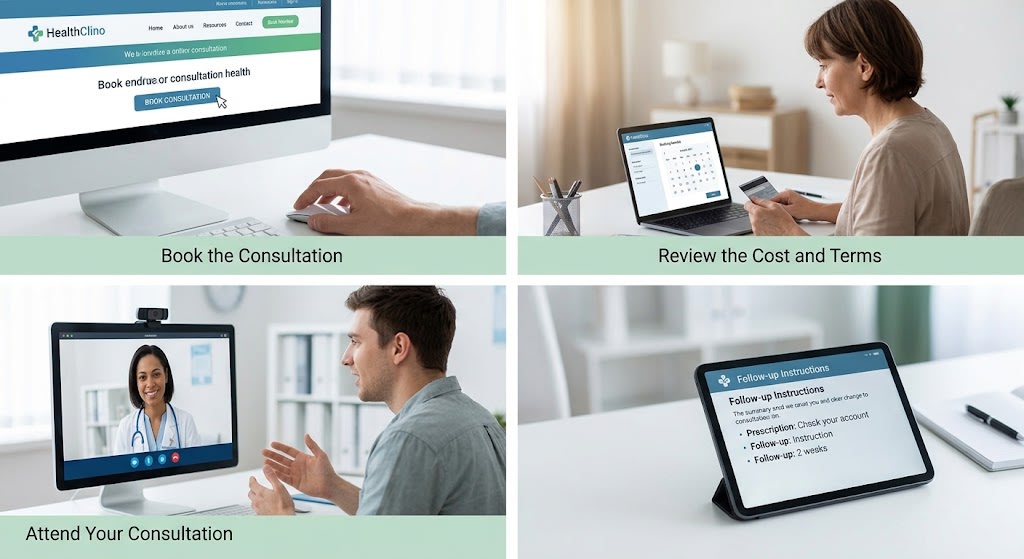
Follow-up instructions
A consultation summary
When you're ready, you can book an online doctor consultation.
How to Book an Online Doctor Consultation
If you have never used an online doctor service before, the booking process may seem unfamiliar. In most cases, it involves a few simple steps.
Step 1: Choose a Legitimate Provider
Look for a provider that clearly identifies its healthcare professionals, explains its services, publishes privacy information, and provides transparent pricing and terms.
Step 2: Choose the Type of Consultation
Depending on the platform, you may be able to choose between general medical care, GP consultations, specialist services, follow-ups, prescription-related services, or other healthcare options.
Step 3: Select an Available Appointment
Choose an appointment time that works for you. Some services may provide same-day or shorter-notice appointments depending on availability.
Step 4: Provide Your Medical Information
Complete the medical intake questions accurately. Include relevant symptoms, medications, allergies, and existing conditions.
Step 5: Review the Cost and Terms
Before confirming your appointment, check the consultation price, cancellation policy, refund conditions, and whether additional services may involve additional fees.
You can review current offers and packages before booking.
Step 6: Attend Your Consultation
Use the instructions provided by the service to join your video, telephone, or online consultation.
Step 7: Follow the Doctor's Recommendations
After assessing your situation, the doctor will explain the recommended next steps.
If online care is not sufficient, you may be advised to seek an in-person examination, diagnostic testing, urgent care, or another appropriate service.
If you are ready to start, you can book your appointment.
What Can and Can't an Online Doctor Treat?
Online healthcare can be useful for many non-emergency medical concerns, but it is not suitable for every condition.
Whether online care is appropriate depends on your symptoms, medical history, the information available to the doctor, and whether a physical examination or diagnostic testing is necessary.
Conditions That May Be Suitable for Online Care
Depending on the individual situation, online consultations may be appropriate for:
Colds and flu-like symptoms
Some respiratory infections
Some urinary tract symptoms
Allergies and hay fever
Certain skin conditions such as acne, eczema, or some rashes
Mild digestive symptoms
Follow-up consultations
Prescription reviews or renewals where clinically and legally appropriate
Some mental health concerns and routine follow-up
Minor injuries that do not require urgent physical treatment
Certain medical certificates or documentation where appropriate
A doctor should determine whether your specific condition can be safely assessed and managed online.
When Is In-Person Care More Appropriate?
An online consultation may not be appropriate when you need:
A physical examination
Imaging such as an X-ray or ultrasound
Blood tests or other laboratory testing
Wound treatment or stitches
Assessment of a possible fracture
Immediate monitoring
Emergency treatment
Assessment of symptoms that are rapidly worsening or potentially serious
A responsible online doctor should recommend in-person care when remote assessment is not enough.
When Should You Not Use an Online Doctor Consultation?
Do not rely on an online doctor consultation for a suspected medical emergency.
Examples of potentially serious symptoms include:
Severe or sudden chest pain
Significant difficulty breathing
Severe or sudden headache
Loss of consciousness
Uncontrolled bleeding
Severe allergic reaction
Sudden weakness or numbness
New confusion
Signs of a possible stroke
One commonly used way of recognizing possible stroke symptoms is the FAST approach:
F — Face: One side of the face may droop.
A — Arms: One arm may become weak or drift downward.
S — Speech: Speech may become slurred or difficult to understand.
T — Time: Seek emergency medical help immediately.
If you think you or someone else may be experiencing a medical emergency, contact your local emergency service immediately rather than booking an online consultation.
Can an Online Doctor Prescribe Medication?
In some circumstances, an online doctor can issue a prescription, but this depends on the doctor's clinical assessment, the medication involved, and the laws and regulations that apply where the consultation takes place.
A legitimate provider should not guarantee a prescription before a doctor has assessed you.
Some medicines may have additional restrictions, and certain medications may require an in-person assessment or other safeguards.
The safest approach is to provide the doctor with complete and accurate information about your symptoms, existing conditions, medications, and allergies.
The doctor can then determine whether prescribing medication is appropriate.
For patients who need a repeat prescription review, you can also explore our prescription renewal service.
How Much Does an Online Doctor Consultation Cost?
The cost of an online doctor consultation varies depending on:
The country
The healthcare provider
Whether you see a GP or specialist
The consultation type
The length of the appointment
Whether insurance covers part of the cost
Whether additional services or documents are required
There is no single price that applies to every online doctor consultation across Europe.
For this reason, it is better to check the provider's current price before booking rather than relying on a generic worldwide estimate.
What Should You Check Before Paying?
Before booking, check whether the quoted price includes:
The doctor's consultation
A prescription, where appropriate
A medical certificate, if requested
A referral letter
Follow-up care
Additional administrative fees
You should also review the provider's cancellation and refund policies.
You can compare current offers and packages before choosing a consultation.

Is an Online Doctor Consultation Legal and Safe?
Online healthcare is an established part of healthcare delivery in many countries, but the rules governing telemedicine, prescribing, professional licensing, privacy, and reimbursement can differ between jurisdictions.
Choosing a legitimate provider is therefore important.
1. Check the Doctor's Credentials
A trustworthy provider should make it reasonably clear who is providing medical care.
Look for:
Doctor qualifications
Professional registration where applicable
Medical specialties
Relevant experience
Clear information about the clinical team
You can browse our doctors before booking.
2. Check How Your Data Is Handled
Medical information is sensitive.
Before using an online healthcare provider, look for a clear privacy policy explaining:
What information is collected
Why it is collected
How it is stored
Who may access it
How long it is retained
Your rights regarding your information
For users in the European Union, look for clear information about GDPR and data protection.
You can review the HealthClino privacy policy before using the service.
3. Avoid Providers That Guarantee Prescriptions
A service that promises a prescription regardless of your symptoms should be treated cautiously.
A doctor should assess your medical situation first and then decide whether medication is appropriate.
4. Check Pricing and Terms
Before paying, understand:
The consultation price
Cancellation rules
Refund conditions
What happens if online care is not appropriate
Whether follow-up consultations cost extra
Whether additional documents involve additional charges
You can review our terms and conditions and policies.
5. Look Beyond Individual Reviews
Online reviews can provide useful information, but one review does not necessarily represent the overall quality of a healthcare service.
Look for repeated patterns involving:
Unexpected charges
Appointment problems
Difficulty contacting support
Poor communication
Privacy concerns
Problems receiving documentation
You can also learn more about HealthClino through our about us page.

Online Doctor Consultation Across Europe
Telemedicine is increasingly used across Europe, but the way healthcare services are regulated, reimbursed, licensed, and delivered varies between countries.
For patients, this means you should not assume that the rules applying to an online doctor consultation in one country automatically apply in another.
Online Doctor Consultation in Spain
Online medical consultations are available in Spain for a range of healthcare needs, particularly where a physical examination or immediate emergency treatment is not required.
Depending on the service and clinical circumstances, patients may be able to use online consultations for:
Common illnesses
GP advice
Follow-up care
Some skin concerns
Prescription-related consultations
Medical certificates where appropriate
You can learn more about the countries and healthcare services currently supported by HealthClino on our countries page.
Online Doctor Consultation in Italy
Telemedicine services are available in Italy, but the exact rules and availability depend on the type of service, healthcare professional, and clinical situation.
If you are in Italy, check whether the provider supports your location and whether the service you need can legally be delivered online.
Online Doctor Consultation in France
France has established systems for teleconsultation, but eligibility, reimbursement, and provider requirements can vary.
Patients should confirm whether a particular consultation qualifies for reimbursement before booking.
Online Doctor Consultation in Germany
Germany has established pathways for remote medical consultations, but requirements for virtual care, prescribing, and reimbursement depend on the circumstances and applicable regulations.
Online Doctor Consultation in the UK
Online GP and other remote healthcare services are widely available in the UK through both public and private providers.
The exact process depends on whether you are using NHS services or a private provider.
What About Cross-Border Prescriptions?
Cross-border healthcare within the EU has specific rules and systems. A prescription issued in one country should not automatically be assumed to work in every other country.
If you are travelling or receiving healthcare across borders, confirm with the healthcare provider and pharmacy whether a particular prescription can be used in the country where you intend to obtain the medication.
For current HealthClino availability, visit our countries page or contact our team.
Benefits and Limitations of Online Doctor Consultations
Online healthcare can be extremely useful, but it is not a replacement for every type of medical care.
Benefits of Online Doctor Consultations
Depending on your circumstances, an online consultation may offer:
No need to travel to a clinic
Less time spent waiting in a waiting room
Convenient access from home
Easier access for people with mobility or travel limitations
Convenient follow-up care
Access to healthcare while travelling, where appropriate
Greater privacy for some sensitive concerns
Potentially faster access for certain non-emergency needs
For many patients, the biggest advantage is convenience: you can access an appropriate healthcare professional without necessarily reorganizing your entire day around a clinic visit.
Limitations of Online Doctor Consultations
There are also important limitations:
A doctor cannot perform every type of physical examination remotely.
Some conditions require imaging or laboratory tests.
Some symptoms are difficult to assess without an in-person examination.
Internet, device, or audio/video problems can interfere with a consultation.
Some prescriptions or treatments may have additional legal restrictions.
Some insurance plans may treat virtual and in-person care differently.
Emergency symptoms require appropriate urgent or emergency care.
The question is therefore not whether online care is always better than in-person care.
The better question is:
Is an online consultation appropriate for this particular health concern?
A qualified doctor should help answer that question.
Online Doctor Consultation vs In-Person Doctor Visit
Both forms of healthcare have an important role.
FeatureOnline doctor consultationIn-person consultationTravel to clinicUsually not requiredUsually requiredWaiting roomUsually avoidedMay be requiredVideo/telephone assessmentYesUsually noPhysical examinationLimitedAvailableLaboratory testsNot performed during the remote consultationMay be available or arrangedImagingNot performed during the remote consultationMay be arrangedFollow-up careOften possibleOften possibleEmergency treatmentNot appropriateAppropriate emergency services should be usedBest suited forSelected non-emergency concernsConditions requiring examination, testing, procedures, or closer assessment
Neither option is automatically better for every situation.
A doctor should recommend in-person care when the information available remotely is not enough to safely assess or manage your condition.
How to Prepare for an Online Doctor Appointment
A few minutes of preparation can make your consultation more useful.
Test Your Technology
Before your appointment, check:
Internet connection
Camera
Microphone
Speakers
Login details
Required application or browser permissions
Do this before the appointment rather than waiting until the consultation starts.
Write Down Your Symptoms
Consider noting:
When symptoms started
Whether they are improving or worsening
What makes them better or worse
Any associated symptoms
Whether you have experienced something similar before
Prepare Your Medication List
Have information about:
Current medications
Dosages
Allergies
Supplements
Recently stopped medications
If you do not know the exact name of a medication, a clear photograph of the packaging may help.
Prepare Relevant Photos
For some visible concerns, such as certain skin problems, a clear photograph may provide useful additional information.
Use good lighting and make sure the image is in focus.
However, a photograph cannot replace a physical examination when one is clinically necessary.
For skin-related concerns, you can also learn about our online dermatology service.
Find a Private Space
Choose a quiet and private location where you can speak openly with the doctor.
This can also make it easier for the doctor to hear you clearly.
Have Your Questions Ready
Write down anything you want to ask before the consultation.
This can help you remember important questions during your appointment.
What Happens If an Online Doctor Cannot Treat You Remotely?
This is an important part of safe online healthcare.
Sometimes a doctor may conclude that your condition needs:
A physical examination
Blood tests
Imaging
Specialist assessment
Urgent treatment
Emergency care
That does not necessarily mean the online consultation was unsuccessful.
The purpose of a medical consultation is not to guarantee a particular treatment. It is to assess your situation and determine the safest appropriate next step.
A responsible online doctor may therefore recommend that you visit a local clinic, GP, urgent care service, emergency department, or specialist.
Frequently Asked Questions About Online Doctor Consultations
Can an online doctor prescribe medication?
An online doctor may be able to prescribe certain medications when clinically appropriate and legally permitted. However, prescribing depends on the patient's condition, medication, country, and applicable regulations. Some medicines may require additional assessment or an in-person consultation.
Does insurance cover online doctor visits?
Insurance coverage varies by country, insurer, plan, and type of consultation.
Before booking, check whether your insurance covers telemedicine and whether you need to pay first and request reimbursement later.
How fast can I get an online doctor consultation?
Availability varies between providers, consultation types, locations, and appointment schedules. Some services may offer same-day or short-notice appointments, while scheduled or specialist consultations may require more time.
Check the provider's current availability before booking.
Can online doctors write sick notes or medical certificates?
Some online doctors may issue medical certificates or sick notes when clinically appropriate and legally permitted. Requirements vary by country and situation.
If you need a medical certificate for work or another eligible purpose, you can review our sick note service.
Is my health data safe during an online consultation?
Healthcare providers should have appropriate safeguards for protecting patient information.
Before using a service, review its privacy policy, data protection information, security practices, and applicable regulatory obligations.
For users in Europe, check what information the provider gives about GDPR and your data protection rights.
Can I use an online doctor consultation while travelling?
This depends on the provider, the country where you are located, the doctor's licensing arrangements, and the type of healthcare you require.
Do not assume that an online consultation available in your home country can automatically be provided while you are abroad.
What happens if the online doctor cannot fully assess me?
The doctor may recommend an in-person consultation, additional testing, urgent care, or specialist assessment.
This is an important safety feature of responsible telemedicine rather than a failure of the service.
Is an online doctor consultation suitable for children?
Online consultations may be appropriate for some childhood health concerns, but suitability depends on the child's age, symptoms, medical history, and the type of assessment required.
If a child appears seriously unwell or has emergency symptoms, seek urgent medical care rather than relying on an online consultation.
What is the difference between telemedicine and an online doctor consultation?
Telemedicine is a broader term for remote clinical healthcare delivered using communication technologies. An online doctor consultation is one common type of telemedicine service.
Telemedicine can include both synchronous care, such as a live video consultation, and asynchronous care, where information is submitted and reviewed later.
Can I get an online doctor consultation without insurance?
Yes. Some private telemedicine providers offer self-pay consultations. Whether insurance is required depends on the provider and healthcare system.
Always check the total cost before booking.
What should I do if an online doctor recommends an in-person examination?
Follow the doctor's recommendation and arrange appropriate in-person care.
An online consultation cannot replace a physical examination when one is necessary. If your symptoms are urgent or worsening, seek the appropriate urgent or emergency medical service.
Is an Online Doctor Consultation Right for You?
An online doctor consultation can be a convenient option for many non-emergency health concerns, routine follow-up needs, and situations where travelling to a clinic is difficult.
It may be particularly useful when you need medical advice but do not necessarily require an immediate physical examination.
However, online healthcare has clear limitations.
If you have severe or rapidly worsening symptoms, symptoms suggesting a medical emergency, or a condition that requires a physical examination, diagnostic testing, or urgent treatment, seek appropriate in-person medical care instead.
For everyone else, choosing a transparent and legitimate healthcare provider can make online medical care a practical part of managing your healthcare needs.
If you are ready to speak with a doctor, you can book your online doctor consultation.
You can also:
Medical Disclaimer
This article is provided for general informational purposes only and is not a substitute for professional medical advice, diagnosis, or treatment.
Always seek advice from a qualified physician or other healthcare professional regarding your individual medical circumstances. Do not disregard professional medical advice or delay seeking medical care because of information contained in this article.
If you think you may be experiencing a medical emergency, contact your local emergency service immediately.
Medical review: This article was reviewed by the HealthClino Medical Review Team for general clinical accuracy. Medical information, healthcare regulations, and telemedicine requirements can change, so the content should be reviewed periodically and updated when appropriate.
Sources and further reading: This article draws on publicly available guidance from organizations including the World Health Organization and European Union institutions regarding telemedicine, digital healthcare, and cross-border healthcare.